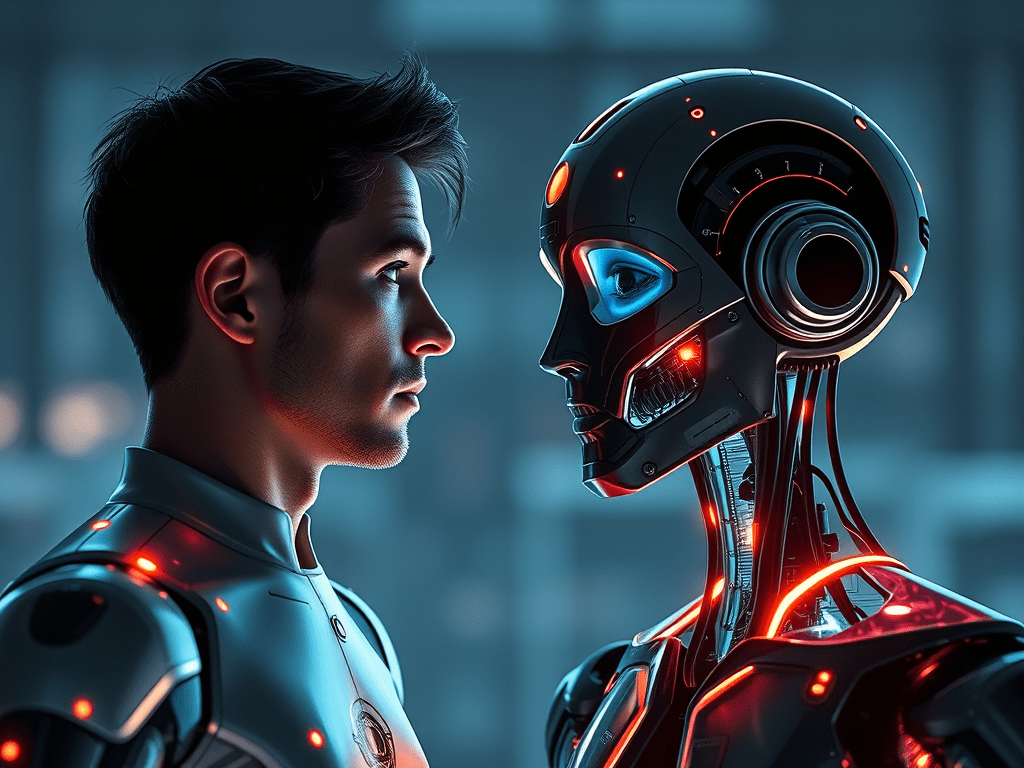
“AI’s growth isn’t gradual—it’s explosive.
By the time many realize its full impact,
it may already have transformed industries,
workplaces, and livelihoods beyond
recognition. Can we afford to wait?”
From farmers to astronauts, from morning alarms to midnight playlists, Artificial Intelligence (AI) touches everyone’s life today—knowingly or unknowingly. Whether we accept it or not, AI has permeated our personal, professional, and social lives—often without our conscious consent.
The concept of AI dates back to the mid-20th century, but its true potential has only begun to unfold in recent decades. For years, progress was slow and quiet, but the past three decades brought major breakthroughs: in 1997, IBM’s Deep Blue defeated world chess champion Garry Kasparov; in 2011, IBM’s Watson won Jeopardy; in 2012, a landmark neural network paper showed image recognition (famously identifying cats); in 2017, Google Brain scaled deep learning; and in 2018, OpenAI released the first ChatGPT. Together, these milestones chart AI’s rapid journey from concept to everyday reality.
We often hear terms like Artificial Intelligence (AI), Machine Learning (ML), Deep Learning, Computer Vision, Natural Language Processing (NLP), Robotics (uses knowledge of multiple fields), and Data Science—sometimes even used interchangeably. But what do they really mean? In simple terms, most of these are subsets of AI (the big umbrella). Deep Learning, an advanced form of ML inspired by the way the human brain works, relies on artificial neural networks to learn patterns and generate outcomes. Data Science, on the other hand, is a broader discipline that extracts insights from data using AI/ML, traditional statistical methods, and domain expertise. Whether training an ML model or making inference from a statistical model, data quality is everything. If we imagine the ML model as a student, then the Data Scientist is the teacher. The teacher provides well-prepared study material (high-quality data), enabling the student to learn, improve, and deliver accurate results.
Have you ever wondered how deeply AI is woven into our daily lives? From movies to music, AI quietly shapes our experiences. When you stream a film on an OTT platform like Netflix or Prime Video, or listen to music online, AI analyses your viewing and listening history to recommend your next choice. These machine learning (ML) models continuously track and adapt to your preferences, often using reinforcement learning—where the system improves by interacting with your environment—to create a personalized experience. This form of AI, known as “Narrow AI,” focuses on specific tasks with limited capabilities. Common examples include digital voice assistants, chatbots, image and speech recognition tools, and translation applications.
Moving into the professional space, what comes to mind immediately? ChatGPT, Google Gemini, DeepSeek, and many others can assist with daily tasks such as drafting write-ups, emails, recommending the best course of action, reading and generating images, creating feasibility reports, analysing data for decision-making, and even helping with excel formulas, coding, and much more. Microsoft Copilot supports almost every application in the Microsoft suite—helping create presentations, draft documents, analyse data, provide business insights, and write professional responses in just minutes.
For designers, tools like Canva (Magic Design), Adobe Firefly, Uizard, and Khroma aren’t just assistants—they’re game-changers. From generating images in seconds to turning text into designs, sketching auto-wireframes, prototyping products, and crafting personalized colour palettes, these AI-powered platforms supercharge creativity and cut design time in half. When it comes to Customer Relationship Management (CRM), the game has completely changed. Today’s leading CRMs are AI-powered by default—automating support workflows, detecting customer sentiment in real time, and delivering predictive analytics that can forecast sales pipelines with uncanny accuracy.
But this is just the beginning. AI is still evolving, with the ultimate breakthrough being Artificial General Intelligence (AGI)—a stage where machines surpass human intelligence across multiple domains. As Sam Altman, CEO of OpenAI, puts it, AGI could be “the most powerful technology humanity has ever created.” Imagine an intelligence not just assisting us, but outperforming us in countless ways. That future may not be as far off as it seems.
AI is no longer knocking on doors—it’s already everywhere. The real question is: is this a promise or a peril? Will AI remain humanity’s most powerful ally, streamlining tasks, accelerating workflows, and unlocking astonishing new possibilities? Or will it become a double-edged sword, displacing millions of jobs before society has time to catch up? AI holds limitless potential for humanity—but without ethical choices, it could also become our greatest threat. One thing is clear: AI’s growth isn’t gradual—it’s explosive. By the time many realize its full impact, it may already have transformed industries, workplaces, and livelihoods beyond recognition. Can we afford to wait?
TechPulse, By Binu Nambiar

 BINU NAMBIAR
Leave a comment